Tuesday, May 4, 2010

April 5 - Sisters of Providence Feeding Ethnic Minority Students in Vinh Quang

We visited the parish of the Sisters of Providence. To encourage ethnic minority children to go to school, every morning they feed soy milk to 400 children before they go to classes. At lunch time they feed 100 of them.


We had arrived just as they were sitting down for their lunch.


While this may look very nourishing, for this lunch meal they serve up a watery broth with a bit of rice, vegetables and, if available, just a hint of meat. The children were all appreciative of whatever they were given.


This is the older of the children cleaning up the dishes after lunch. Not quite up to our Western standards for sanitation but it's all they have to work with.
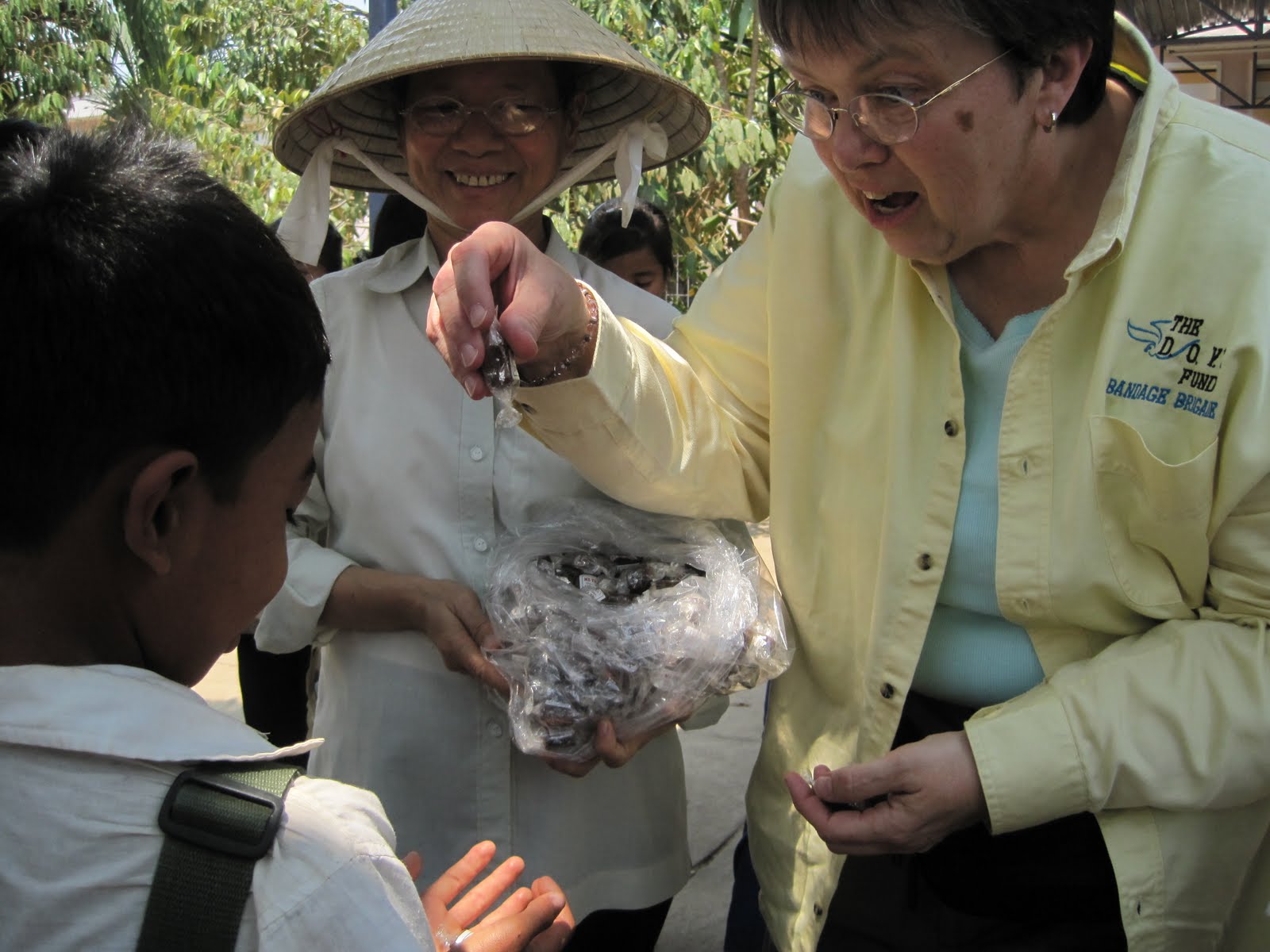

We were having fun handing out candies to the kids after their lunch.


Started counting out the candies to them (1 to 4), in English, and was surprised how well they did and how eager they were to play my "game".


Some like this young man seemed to learn it while standing in line. I was congratulating him on a job well done and he was just beaming with pride.

What shocked me was that as I hugged them I realized how very thin these little ones were under their clothing. It was obvious that these supplemental meals they receive at this facility are very important to them.


Gary was soon working his charm with the young people demonstrating and getting them to participate in his special hand shake.


Everyone wanted to get into the act and seemed to enjoy the friendship and playful attitude of this American visitor.


This elderly nun was not going to be left out of the fun and everyone enjoyed the show that she and Gary put on.


These nuns are obviously doing a great job with these young people. They all seemed clean, happy and eager to learn. No shy ones in this group when it came to taking their pictures.


We were so impressed with the quality of care and support to these children that we found ourselves making a token donation to help buy food for them before we left.

Monday, May 3, 2010

Thank You For Your Patience


A big thank you to everyone for continuing to check in on our progress in getting this story properly told.

I have so much more to share with you but want to make sure to do it right.

Next posts you can look forward to will cover our visits to
* numerous orphanages and schools in Kon Tum
* a school for young minority women studying to become nuns
* and then our final leper village visit (keep your tissue handy)

As we write these we are also putting together a power point presentation and actively booking group presentations we will be doing to illustrate our story.

Life is full of blessings and we are so happy to share them with you!

A Mosaic of Ethnic Minorities


Commonly known as "hill tribes", a mosaic of ethnic minorities inhabits the mountainous regions of Vietnam.

The French called these ethnic minorities Montagnards (highlanders or mountain people) and this term is still used today. The Vietnamese traditionally referred to them as "moi", a derogatory term meaning savages, which reflects all too common attitudes among lowland majority Vietnamese.

The current government prefers the term "national minorities". There are more than 15 separate groups each with their own dialect which further complicates their integration into mainstream Vietnam for any possible education or meaningful employment.

Without any outside intervention, many of the children of these remote tribes would never see or know anything of the outside world.


Our good friend Mr. Minh, has sponsored annual Summer Camps specifically for these isolated children, many of them children of minority lepers. This camp is held for three days in July or August.

Depending upon the availability of donated funds they bring together 500 to 600 children between the ages of 10 and 20 years. They alternate...one year younger kids, next year older kids. The biggest cost is transportation for the kids from their remote locations. He calculates that it costs $10 each for transportation and food.

This is a very important project because without it most of these children NEVER go out of their villages. All they ever see is dirt, poverty and no education. Bringing them out to see the outside world and meet others is very important to break the cycle of their impoverished existence.

He was very sad to tell us that he was not certain that he would obtain enough donations to hold this event this year.

April 5 - The "Capitol City" of Kon Tum Province

Last year our hearts were wrenched when we received the message from Mr. Minh regarding the damage in Kon Tum Province from Typhoon Ketsana. He had relayed to us that the people were literally starving. While in Pleiku (which is Gia Lai Province) we were just south of the Kon Tum areas which were hardest hit by that disaster.

We were fortunate enough to have Mr. Minh graciously take us for a full day road trip visiting needy facilities in Kon Tum Province.


As we traveled the streets of the Kon Tum town (the capitol of Kon Tum Province) I noted the typical living quarters in an attempt to share with you what appears to be the average standard of living in this capitol city.


None of these homes had anything more than the very basic necessities.

Sunday, May 2, 2010

April 4 - A Vietnamese Easter Egg Hunt


During our time in Pleiku, we were the guests of the Convent of Sisters of St. Paul de Chartres. They have been established in Pleiku since 1962. The sisters are very active in pursuit of their mission to provide education and basic health care to the poor, the minorities and lepers in Gia Lai province.

In terms of education, they take care of:
* One kindergarten and day care for 350 children (ages 3-6)
* Two boarding houses for Vietnamese and minority children, especially children of lepers. They lodge and feed over 360 children (ages 5-18)
* One small room for 4 abandoned and handicapped children
* One Love House for 60 children (ages 5-12)

In terms of health care, the sisters provide medical care and food to over 700 lepers, living in 68 remote villages. The nearest villages are 10 km and the farthest 70-80 km from Pleiku city. The sisters usually bring back children of lepers from these villages to raise in the boarding houses to enable their future social integration.

Currently, there are 29 sisters of St. Paul de Chartres, living in 7 different branch communities, widespread in Gia Lai province, with their main house in Pleiku city. We had been sleeping at one of the branch communities, "The Plantation", named for the fact that the surrounding grounds are tended by the sisters where they grow peppers, sweet potatoes, coffee, corn, tapioca, roots, bananas and vegetables for funds to support the nuns.

On this evening, we returned to the main convent in Pleiku to watch the Vietnamese children in their Easter fun. This facility houses about 150 children of lepers, who would otherwise not be able to attend school. The excitement was high as they gathered in the court yard in preparation for an Easter Egg Hunt. They squealed with delight as they were finally released into the gardens and walkways of the convent on their quest for treasure.

Now in America this kind of excitement would only be generated in search for candy or other special treasures. For these Vietnamese children, the search was for plain boiled eggs the nuns had hidden earlier in the day.

It was after dark so I don't have pictures to share as they scattered back and forth. They were even undeterred when someone knocked the head off a saint's statue in the court yard. The Vietnamese take such things casually and I saw one of the adults giggling and carrying the head off down a hall looking for some glue to reattach it.

Soon they were lining up again for a special dinner to be handed out. It was a large bun with ground chicken in it and it was obvious it was a special treat for them.

April 4 - Haven't We Been Here Before??? - Village #6

We were being quite thorough in documenting in words and pictures each of the visits we made. The pace and area we were covering exceeded what we had anticipated. Our itinerary had been laid out by a number of people and we were being hosted and escorted by different people.

We were on remote back roads which were long and dusty with many turns where you least expected a car to turn. Each one was like we should mark the trail in to be able to find our way back out.

You can only imagine our surprise and shock then when we arrived at the end of this long Easter Sunday at a village that looked rather familiar. Our escorts from the day before had not told today's guides that we had been to this village (village #3).


Yikes, our delivery people had sacks of food laid out and these people were excited to think that they were going to get food delivered TWO DAYS IN A ROW!

It was sad but once we realized the mistake that had been made, our guides explained it to these people and pointed out to them that there was another village down the road that, at this point in time, needed the food more than they did.


Typical of the Vietnamese people, the villagers were gracious about it.


We handed out some small items but then the bulk of the food went back into this trailer to be hauled on down the road to another village that would not have otherwise benefited from this gift of love that we were delivering.

Friday, April 30, 2010

April 4 - Easter Gatherings with Lepers (Villages 4 & 5)


We traveled main roads to a large church grounds and could immediately hear singing as we drove in. There were children there gathering to celebrate Easter and play games.


Initially they gathered around as though we were part of their games. Finally we broke lose of the group so we could walk around to the back side of the church and greet the group of lepers waiting for us there. They represented two villages so remote and close to the Cambodian border that we could not visit their actual villages. They had instead traveled to us via a van or their own broken down motor bikes.


Young man in the yellow coat is the leader of one of the villages. He is very young for a leprosy patient but up close you can see that several of his fingers are already missing.


This young man has massive scars and sores all over his head.


We were passing out candies to everyone. After offering a "hand full" to people with no hands...I started putting them in their pockets. Really tore at my heart!


5


Gary is always the center of attention with the children. Here he has a group of young fans around him with one holding his camera taking a picture of him.


We were the lunch guests of this prestigious Vietnamese bishop. He is brother of the only Vietnamese Bishop in the USA (located in Orange County, CA). He was right there ever present interacting with us and the lepers.


Soon there was Gary teaching him his new special handshake (now known as "The Cougar Handshake")


The hand shake was an instant success as an ice breaker wherever we went. Soon everyone was in the act and having great fun.


When it was time to leave, one quiet crippled lady crawled up to Gary and wanted to try it out herself.


We see how badly deformed she was as she crawls over to the van to return to her village...but yet willing enjoy the simple things in life...like a silly hand game played with a strange American man.